Guide
What is a stitch regulator on a quilting machine?
Published
Note: This page contains affiliate links. If you buy through them we may earn a commission at no extra cost to you. Learn more
In short
A stitch regulator is a sensor system that measures how fast you move the quilt during free motion quilting and adjusts the needle speed to match, so each stitch comes out roughly the same length. Without one, stitch length depends entirely on how well you coordinate your hands with the foot pedal. Examples on domestic machines include the Janome A.S.R. (Accu Stitch Regulator) and Bernina's BSR (Bernina Stitch Regulator).
Products for this job
Compare all 7 productsJanome MC9480QC: stitch regulator and ruler foot
Check price on AmazonAffiliate linkJanome MC6700P: 255 mm harp and AcuFeed Flex
Check price on AmazonAffiliate linkJanome Skyline S6 AE: 8.25 in workspace, 196 stitches
Check price on AmazonAffiliate link
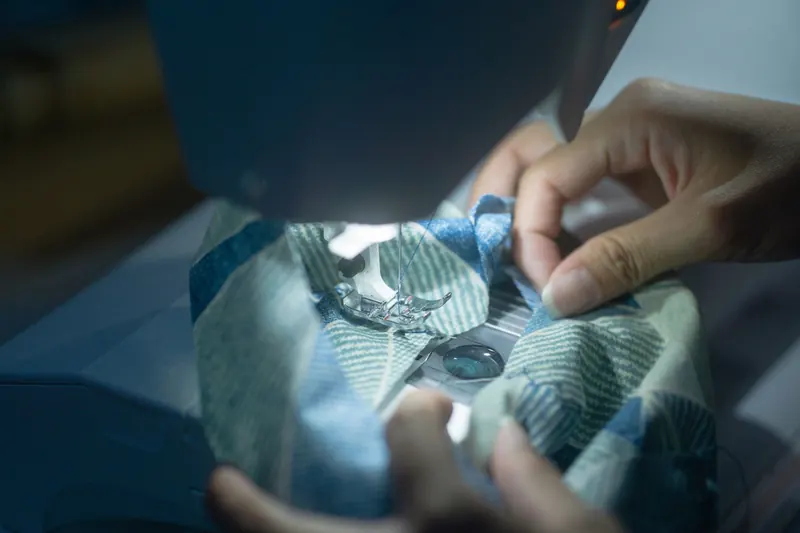
Free motion quilting gives you complete freedom over the design, but it also hands you a tricky job: keeping the stitch length even while you steer the quilt by hand. Move too slowly and stitches bunch up; move too quickly and they stretch into long, uneven lines. A stitch regulator is a feature designed to take some of that coordination off your hands. This explainer covers how stitch regulators work, what they can and cannot fix, which machines offer one, and whether a beginner needs one at all.
The problem a stitch regulator solves
On a normal sewing machine, the feed dogs move the fabric a fixed distance for every stitch, which is why the stitch length dial controls stitch length. In free motion quilting the feed dogs are lowered or covered, and you move the fabric yourself. The machine no longer knows how far the fabric has travelled, so the length of each stitch depends on two things: how fast the needle is going and how fast your hands are moving.
Getting those two in balance takes practice. Most quilters go through a stage of tiny stitches on curves, where hands naturally slow down, and long jumpy stitches on straight runs, where hands speed up. A stitch regulator aims to smooth out that unevenness by linking the needle speed to your hand speed automatically.
How a stitch regulator works
Stitch regulators use a sensor, usually built into a special free motion foot or positioned under the needle area, that reads the movement of the fabric. The machine's computer then varies the needle speed so it puts in stitches at a set length. Move the quilt faster and the needle speeds up; slow down and the needle slows down; stop and, depending on the mode, the needle may stop as well.
Most systems let you choose the target stitch length and offer more than one mode, for example a mode where the needle keeps moving slowly when the fabric stops, which helps when you want to pause on a point. The exact sensor design, modes and controls differ from maker to maker, so check the machine's manual for how its regulator behaves.
- 1
You fit the regulator foot or switch the regulator mode on, and lower the feed dogs.
- 2
You set the preferred stitch length on the machine.
- 3
The sensor reads how quickly and in which direction the fabric is moving.
- 4
The machine adjusts the needle speed so the stitches stay close to the chosen length.
- 5
When you stop moving the fabric, the needle slows or stops according to the selected mode.
Which machines have a stitch regulator?
Stitch regulators are found mainly on higher end quilting and sewing machines and on long arm and sit down quilting machines, rather than on entry level models. Bernina's BSR is the best known example on domestic machines and is offered as an accessory or built in on a number of its models; check Bernina's specification for the model you are looking at.
Janome offers its A.S.R. (Accu Stitch Regulator) on some machines. Among the models in our best sewing machines for quilting guide, the listings for the Janome Horizon MC9480QC and the Janome Continental M8 mention the A.S.R. feature. Many other quilting machines, including well regarded ones, do not include a regulator, so do not assume a machine has one unless the maker's specification says so.
If you are shopping specifically for this feature, search the product specification for the maker's own name for it, such as A.S.R. or BSR, rather than relying on general descriptions like quilting machine.
| Maker | Name of the feature | Where to check |
|---|---|---|
| Bernina | BSR (Bernina Stitch Regulator) | Bernina model specification or dealer |
| Janome | A.S.R. (Accu Stitch Regulator) | Listed for the Horizon MC9480QC and Continental M8 |
| Other makers | Varies, often not offered on domestic models | Maker's specification and manual |
What a stitch regulator cannot do
A regulator evens out stitch length, but it does not steer the quilt or design the pattern for you. Smooth curves, consistent spacing between lines of quilting and a relaxed, steady movement still come from practice. Very jerky movements can also outpace the sensor, so the stitch length may still vary when you change direction sharply.
It does not fix problems caused by poor basting, the wrong needle or unbalanced tension either. If you see loops on the back or puckers in the sandwich, look at the basics first: our beginner's guide to machine quilting covers basting and setting up for free motion, and the tension guide explains balancing upper and bobbin threads.
Do you need a stitch regulator?
Plenty of quilters produce beautiful free motion work without a regulator. Practising on small test sandwiches, keeping a steady pedal speed and moving your hands smoothly will get you most of the way. Some machines also have a speed limiting slider, which makes it easier to hold a consistent needle speed while you learn.
A regulator is most worthwhile if you plan to do a lot of free motion quilting, find hand and foot coordination frustrating, or want more consistent results on large quilts. If you mainly do straight line quilting with a walking foot, it adds little, because the feed dogs control stitch length in that case. Weigh it against other quilting features such as throat space, an extension table and a knee lifter, which help with every quilt you make.
- Worth considering: frequent free motion quilters, large quilts, anyone who struggles with uneven stitch length
- Less important: straight line and walking foot quilters, occasional quilters, dressmakers
- Alternatives that help: a speed control slider, practice sandwiches, quilting gloves and a smooth slider sheet on the bed
Frequently asked questions
Does a stitch regulator work with the feed dogs up? Stitch regulators are designed for free motion quilting, where the feed dogs are lowered or covered and you move the fabric. With the feed dogs up, the machine already controls stitch length through normal feeding, so the regulator is not needed.
Which Janome sewing machines have a stitch regulator? Janome calls its system A.S.R. Among the machines in our quilting guide, the listings for the Janome Horizon MC9480QC and Continental M8 mention it. For any other model, check Janome's own specification before assuming it is included.
Is a stitch regulator the same as a speed control? No. A speed control limits the maximum speed of the needle. A stitch regulator measures how the fabric is moving and adjusts the needle speed to keep stitch length even, which is a different job.
Can I add a stitch regulator to my existing machine? Generally only if the maker offers one for that specific model, as the sensor has to work with the machine's electronics. Check the accessory list for your model or ask a dealer; most machines cannot be retrofitted.
What you need
- Check price on AmazonAffiliate link
Janome MC9480QC: stitch regulator and ruler foot
- Check price on AmazonAffiliate link
Janome HD3000BE: metal body plus quilting kit
- Check price on AmazonAffiliate link
Janome JW8100: 100 stitches, 7 buttonhole styles