How-to
Which sewing machine needle for denim and jeans?
Published
Note: This page contains affiliate links. If you buy through them we may earn a commission at no extra cost to you. Learn more
In short
Use a denim (jeans) needle, usually size 100/16 for standard jeans fabric. Drop to 90/14 for lightweight or stretch denim, and go up to 110/18 for heavy denim or when sewing through many layers at seams and hems. A denim needle has a sharp point and a strong blade that pierces tightly woven cotton twill without bending or skipping stitches.
Products for this job
Compare all 7 productsJanome HD3000BE: metal body and 13 feet in the box
Brother HF27: J foot levelling button and metal plate
Singer 4411: 1,100 stitches a minute, extra high lift
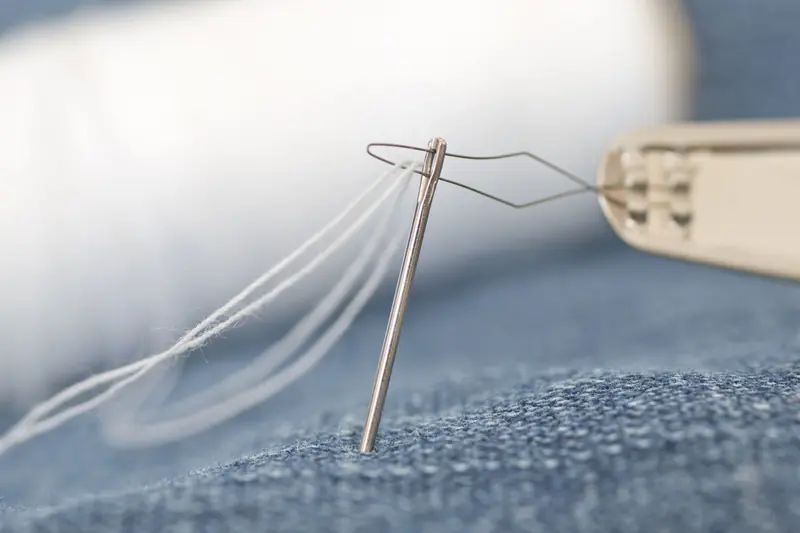
Denim is a dense, tightly woven twill, so a general purpose needle tends to deflect, skip stitches or snap. The right needle is a denim or jeans needle in a size matched to the weight of the fabric and the number of layers at the seam. This article gives the sizes, explains when to change to a topstitch or stretch needle, and covers the habits that stop needles breaking on thick hems.
The short answer: denim needle sizes
Denim needles are sold in the same metric and US size pairs as other needles, and they are usually available from about 70/10 up to 110/18. For clothing you will mostly use three sizes. The fabric weight and the thread decide which one is right, so start with the table and adjust after a test seam on a folded scrap.
Our needle size chart explains the numbering system in full, including how sizes pair up between metric and US.
| Needle size | Use it for |
|---|---|
| 90/14 | Lightweight or stretch denim, chambray, denim shirts |
| 100/16 | Standard jeans fabric and denim skirts, most single and double layers |
| 110/18 | Heavy denim, canvas and many layers at seams and hems |
Why a denim needle works better than a universal one
A denim needle has a very sharp point and a reinforced, slightly stiffer blade. The sharp point cuts a clean hole through the tight weave instead of pushing threads aside, and the stronger shaft resists bending when it hits a thick seam. A universal needle has a slightly rounded point and can skip stitches or break on the same fabric.
The difference shows most at flat felled seams, belt loops and waistband joins, where the machine sews through four or more layers. A needle that deflects there can end up in the needle plate or the bobbin case. For the hardest jobs you may also need a machine with a strong motor and a high presser foot lift, which our guide to the best sewing machines for denim compares.
Topstitching jeans and thicker thread
Jeans are traditionally topstitched in a thicker thread, which needs a bigger eye. A standard denim needle can be used for decorative topstitching with thread labelled as topstitching or jeans thread, but if the thread shreds or the stitches look uneven, change to a topstitch needle in 90/14 or 100/16. Topstitch needles have a larger eye and deeper groove, so the thicker thread slides through without fraying.
Lengthen the stitch for topstitching, since a longer stitch of about 3 to 4 mm looks neat and sits flat on thick fabric. You can use a thicker thread on top and normal all purpose thread in the bobbin, but you may need to loosen the upper tension a little. Test on scrap first.
Stretch denim and lighter weights
Most modern jeans contain a small amount of elastane. On those fabrics, a denim needle in 90/14 often works well, but if you get skipped stitches, a stretch or jersey needle in the same size is worth trying, because its modified scarf helps the hook catch the loop on stretchy fabric. Lightweight denim and chambray sew well with a 90/14 or even an 80/12.
For hems on finished jeans, where you cut through the original topstitching and stitch over the thick felled seam, see our guide to hemming jeans with a sewing machine.
Stopping needles breaking on thick seams
Most broken denim needles happen at bulky joins. A few habits cut the risk. Slow down and turn the handwheel by hand over the thickest part, so the needle cannot be forced. Flatten the seam with a hammer first and use a hump jumper or a folded piece of denim under the back of the foot, so the foot stays level as it climbs the ridge.
Never pull or push the fabric, because the machine feeds it, and a pull can bend the needle into the plate. Denim also blunts a needle faster than most fabrics, so fit a new one at the start of each pair of jeans and again if you hear a thudding sound. If you need help fitting one, our step by step needle change guide covers it.
- 1
Fit a new denim needle in 100/16 or 110/18.
- 2
Use a longer stitch length, about 3 to 3.5 mm.
- 3
Slow to a moderate speed on thick seams.
- 4
Level the foot with a hump jumper or folded fabric.
- 5
Turn the handwheel by hand across the bulkiest section.
Frequently asked questions
What size needle for jeans? A 100/16 denim needle suits most jeans fabric. Use a 90/14 for lightweight or stretch denim and a 110/18 for heavy denim or very thick seams.
Can I sew denim with a universal needle? You can on lightweight denim, but a universal needle is more likely to skip stitches or break on heavy fabric. A denim needle is a cheap upgrade.
Do I need a special machine to sew denim? Not for light and medium denim, but heavy duty machines cope better with thick hems. Our heavy duty machine guide lists models stated to handle denim and canvas.
How often should I change the needle when sewing denim? Change it at the start of each project, and sooner if you hear a thudding sound, see skipped stitches or hit a pin. Dense fabrics dull needles quickly.
What you need
- Check price on Amazon
Janome HD3000BE: metal body plus quilting kit